
There is something paradoxical about the prayer lives of many Christians. They know who God is and acknowledge His power, yet they often live and act as if everything ultimately depends on themselves. When trouble comes, they work with panic and desperation, or they carry burdens that weigh them down, all while knowing how loving and caring the Lord is. They believe in prayer, talk about it, and encourage others to pray, yet honest reflection often reveals that prayer is not as natural, frequent, or confident as it ought to be.
The root of the problem may not be a lack of discipline or time. It may be that believers have not sufficiently considered the God to whom they are praying. If God is wise, there is no need to insist on understanding everything before trusting Him. If He is all-powerful, problems beyond human ability need not overwhelm. If He is faithful, there is no reason to imagine He has abandoned His people. When sight of God is lost, security is sought in places that cannot provide it.
Proverbs 18:11 places this false security beside the true one: “The rich man’s wealth is his strong city, and as an high wall in his own conceit.” Whether the reliance is on wealth, fitness, or any other temporary resource, it remains fragile. Solomon sets two kinds of security side by side. The only lasting refuge is found in the name of the Lord.
Know The God Whose Name You Call
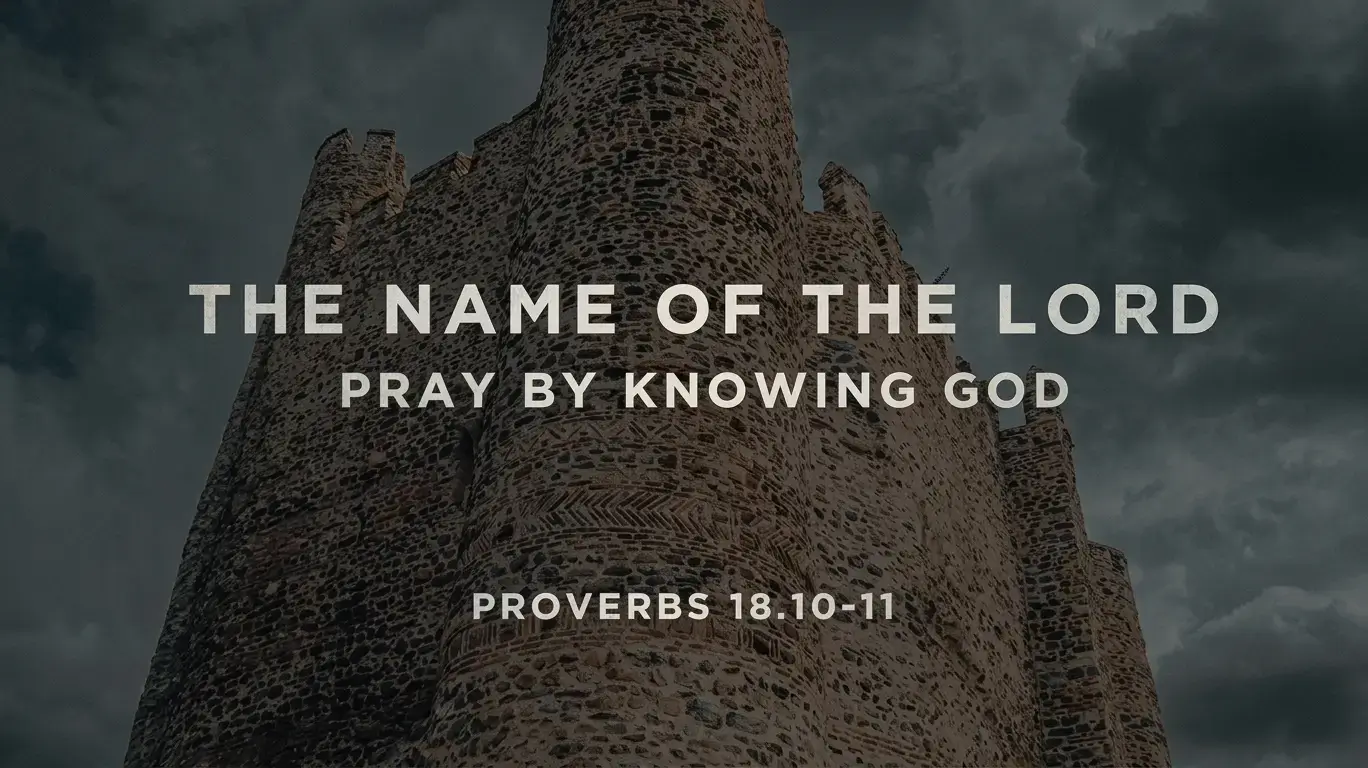
Proverbs 18:10 declares, “The name of the Lord is a strong tower: the righteous runneth into it, and is safe.” Solomon does not simply say that the Lord is a strong tower; he specifically identifies the name of the Lord as that tower. In Scripture, a name reveals character, works, and promises. When Moses asked what name to give the children of Israel, God answered, “I AM THAT I AM” (Exodus 3:14), expressing the essence of who He is rather than merely assigning a title.
The name of the Lord speaks of His attributes. He is merciful. He is Jehovah Tsidkenu, the Lord our righteousness (Jeremiah 23:6). Righteousness does not come through human effort. The Bible states that all our righteousnesses are as filthy rags (Isaiah 64:6), and that there is none righteous, no, not one (Romans 3:10). God made Him who knew no sin to be sin for us, that we might be made the righteousness of God in Him (2 Corinthians 5:21). The most well-known verse in Scripture reminds every person that “God so loved the world, that he gave his only begotten Son, that whosoever believeth in him should not perish, but have everlasting life” (John 3:16).
Anyone who confesses sin, trusts that Jesus Christ paid it all, and calls upon the name of the Lord for forgiveness becomes righteous, not because of personal merit, but because of what Christ accomplished. Jesus taught His disciples to pray, “Our Father which art in heaven, Hallowed be thy name” (Matthew 6:9). Knowing the names and titles of the Lord means knowing Him. Whatever the valley or need, Scripture reveals an aspect of God’s character that addresses it precisely.
One historical example is the missionary John Hyde, known as Praying Hyde. When he prayed, he placed an open Bible before him and rested his hands upon it. He prayed not into thin air, but from the promises, character, and attributes of God found in Scripture. Before asking for what is needed, the believer is encouraged first to remember who God is.
Trust The God Whose Strength You Need
The picture Solomon uses would have been familiar in the ancient world. A strong tower offered protection when danger approached. People sought refuge behind high, thick walls or in fortified structures. The security of those inside the tower did not depend on their own strength; it depended on the strength of the structure itself.
The same is true of the name of the Lord. A person can be weak, discouraged, or depleted of resources, yet still be safe inside that tower. Safety is not dependent on personal ability; it is dependent on Him. The Bible contains many wonderful promises, some of which have become common sayings even among those who do not know the Lord. Yet only the righteous may run into this tower. Righteousness is obtained solely by faith in Jesus Christ.
Scripture reveals different aspects of God’s character through the names He gives Himself. In Genesis 22, Abraham named the place Jehovah-Jireh, “the Lord will provide.” In Exodus 15:26 the Lord declares, “I am the Lord that healeth thee.” The more clearly His character is known, the more confidently He can be trusted.
John Hyde once desired to be a great and well-known missionary, relying on his education and skills. Later he confessed that self occupied a central place in his ambitions. He wanted to accomplish great things for God, yet had not learned to trust God sufficiently to do those things through him. God calls His people to tasks too great for themselves, yet well within the realm of His almighty ability. Whether the role is parent, spouse, grandparent, pastor, or soul winner, the work given is greater than human capacity, but the Lord is able to accomplish it through those who run to Him.
In any difficulty—financial need, a wandering child, uncertain health, or a decision beyond personal wisdom—what Scripture reveals about God speaks directly into the situation. If He is wise, His purposes can be trusted. If He is powerful, He can do what cannot be done. If He is merciful, failures can be brought honestly to Him. If He is faithful, His promises stand even when circumstances appear uncertain. His wisdom may lead to an answer not expected, yet He remains able to do all things.
Run To The God Who Offers You Refuge
The righteous “runneth into it, and is safe.” Running expresses confidence that the destination is right and that safety will be found there. There is a difference between knowing where the refuge is and actually taking refuge in it. The point is not merely to admire God’s character, but to place confidence in Him.
E. M. Bounds, a prolific writer on prayer, rose at four o’clock each morning and spent approximately three hours in prayer before breakfast. He understood the demands of a busy schedule as a pastor, chaplain, and editor, yet he made prayer the first and most important business of his day because he did not believe the work God had given him could be accomplished by human ability alone. The question is not whether anyone can imitate that exact schedule. The question is whether the schedule, whatever it may be, reveals the same dependence on prayer.
Too often the pattern is to worry first, calculate first, seek advice first, and attempt to solve the problem first. Only when nothing else works do people say that all that remains is to pray. One pastor, when told that prayer was needed, half-jokingly replied, “Oh, has it come to that?” Prayer should be the first recourse, not the last.
Everyone runs somewhere when pressure rises. For some it is alcohol, hoping to forget the problem for a few hours. For others it is entertainment or money. Proverbs 18:11 warns that the rich man’s wealth is a strong city only in his own conceit; it will not stand. Solomon, under the inspiration of the Holy Spirit, points to the one refuge that never fails: the name of the Lord is a strong tower.
For those who are saved, the practical step is clear. Identify the situation that is crushing or pressuring this week. Find what the Bible says about God that applies to that situation, and apply it in prayer: “Lord, because You are this, and this is the situation I am facing, I trust You.” Determine to know God better, entrust the burden to Him, and make prayer the first response.
Conclusion
The name of the Lord is a strong tower, and the righteous run into it and are safe. Those who have never trusted Jesus Christ as Saviour can become righteous today. The Lord Jesus said, “Him that cometh to me I will in no wise cast out” (John 6:37). Anyone who confesses personal sinfulness, turns from self-trust and self-effort, and places faith in Christ alone for salvation may call upon the name of the Lord and be received.
Believers already possess that strong tower. The need is to know Him better and to run to Him first when trouble comes. He may change the circumstance, or He may give grace and strength to glorify Himself in it. In either case, the name of the Lord remains the sure refuge.