
Bible Reference: 1 John 2:29-3:10
The apostle John wrote his first letter with a clear purpose: that believers might know they have eternal life. He supplies several practical tests that help God’s people gain biblical assurance. One of those tests is the family resemblance that ought to appear in the life of anyone who claims God as Father. Before turning to the text, Scripture itself invites self-examination. The apostle Paul writes in 2 Corinthians 13:5-6, “Examine yourselves, whether ye be in the faith; prove your own selves. Know ye not your own selves, how that Jesus Christ is in you, except ye be reprobates? But I trust that ye shall know that we are not reprobates.” Such examination is not an invitation to panic or despair; it is a call to honest reflection so that any contradiction between profession and practice may be addressed in the light of God’s Word.
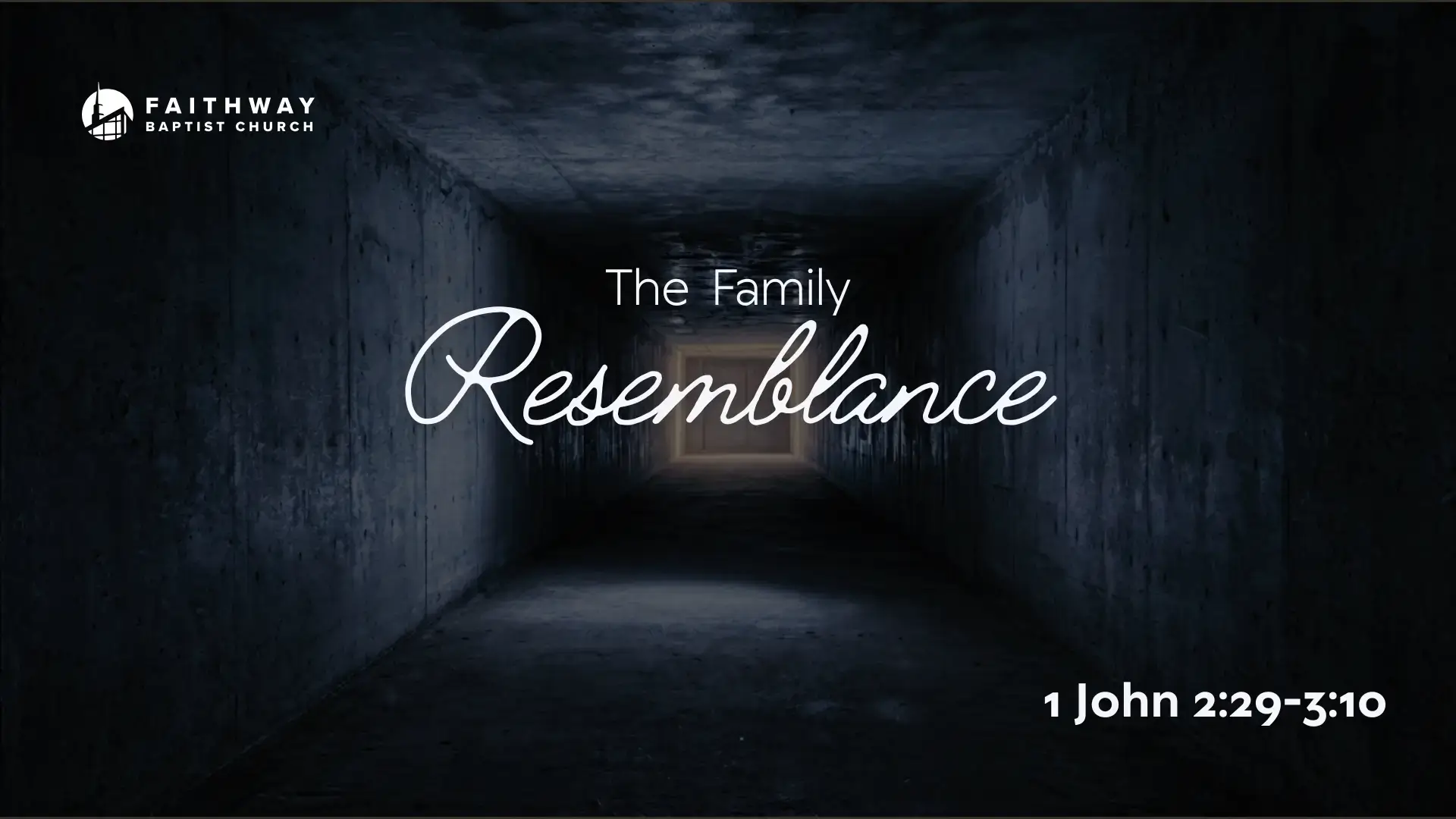
In this message, Pastor Léveillé walks through 1 John 2:29-3:10 under the title “The Family Resemblance.” A child may legally bear his father’s name, yet sooner or later observers look for visible likeness in face, speech, habits or character. The same principle holds spiritually. If God is truly our Father, His moral attributes—righteousness, holiness and love—should become increasingly visible in our lives. This resemblance does not earn or preserve salvation; salvation is received by faith in Christ alone and is kept by Christ alone. Yet the direction and pattern of a believer’s life supply evidence that new birth has occurred.
Marvel at the Love That Made You God’s Child (3:1-2)
The passage opens with an exclamation that demands more than a passing glance: “Behold, what manner of love the Father hath bestowed upon us, that we should be called the sons of God: therefore the world knoweth us not, because it knew him not. Beloved, now are we the sons of God, and it doth not yet appear what we shall be: but we know that, when he shall appear, we shall be like him; for we shall see him as he is.” (1 John 3:1-2, KJV)
The word “behold” calls for contemplation, not mere awareness. It invites us to fix our gaze on this astonishing reality until wonder fills the heart. God, the Creator and Judge of all, has so loved us that He calls us His own children. We are accepted in the Beloved, granted confident access to the throne of grace, and privileged to address the Lord of glory as Father. This truth should never become ordinary. When the wonder fades, we do well to ask the Lord to restore our sense of awe at the privilege of adoption.
The hope of future likeness to Christ carries a present implication. If our ultimate desire is to be with Christ and to be made like Him in eternity, it is inconsistent to have no desire to resemble Him today. Pastor Léveillé illustrates the point with a simple analogy: an aspiring professional athlete who hates training and resents physical contact will never reach the goal. In the same way, a professed longing for heaven that is accompanied by indifference or resistance to Christlikeness now reveals a contradiction. The desire to be like Jesus forever ought to awaken a present desire to walk as He walked.
Reflect the Father Who Gave You New Birth (2:29; 3:3-7)
John continues, “If ye know that he is righteous, ye know that every one that doeth righteousness is born of him.” (1 John 2:29, KJV) In the ancient world, children were expected to reflect their father’s character and frequently to continue in his trade or profession. Joseph was a carpenter; Jesus would have been expected to learn the same craft. Spiritual birth carries a similar expectation. Those born of God ought to display His righteousness.
“Every man that hath this hope in him purifieth himself, even as he is pure.” (1 John 3:3, KJV) While sinless perfection awaits the return of Christ, the child of God desires increasing purity. The verb tenses John employs are decisive. When he writes that “whosoever abideth in him sinneth not” (1 John 3:6, KJV), he is not claiming that true believers never stumble. First John 1:8-2:2 already provides for confession and the advocacy of Christ. The language describes a settled pattern: the one who abides in Christ does not continue in sin as a chosen lifestyle. Habitual, unrepentant sin that no longer troubles the heart raises a legitimate question about whether that person has truly known the Lord.
Righteousness is never the root of salvation; we receive the righteousness of Christ by faith alone. Yet righteous living is the fruit that confirms the reality of that salvation. Where the pattern of life shows no hunger for righteousness and no grief over sin, the profession of faith stands in need of honest examination.
Reject the Pattern That Contradicts Your Profession (3:7-10)
John warns, “Little children, let no man deceive you: he that doeth righteousness is righteous, even as he is righteous. He that committeth sin is of the devil; for the devil sinneth from the beginning. For this purpose the Son of God was manifested, that he might destroy the works of the devil. Whosoever is born of God doth not commit sin; for his seed remaineth in him: and he cannot sin, because he is born of God. In this the children of God are manifest, and the children of the devil: whosoever doeth not righteousness is not of God, neither he that loveth not his brother.” (1 John 3:7-10, KJV)
Once more the continual sense of the verbs is crucial. Those who make sin their settled practice reveal a family likeness to the devil. Those born of God cannot make sin the ongoing direction of their lives, because God’s seed remains in them. Jesus came not only to forgive sins and secure heaven for His people but also to destroy the works of the devil in their present experience. He intends that sin should lose ground and that righteousness should advance.
Two modern illustrations underscore the point. Al Capone built a criminal empire yet insisted he was simply “a businessman giving people the lighter pleasures.” He never saw himself as the villain his actions proved him to be. In a similar way, some who claim the name of Christ continue in known sin without apparent conviction or repentance. Lance Armstrong achieved extraordinary athletic success while concealing a long pattern of performance-enhancing drug use. Even after evidence mounted, his initial response lacked brokenness or a desire to change. When sin ceases to bother us, that very fact ought to trouble us and drive us back to the Lord.
Conclusion
The purpose of this passage is not to unsettle genuine believers but to anchor assurance in biblical evidence. Full assurance grows as the Holy Spirit produces an increasing desire for righteousness and a decreasing tolerance for sin. We are not saved by works, yet genuine faith always bears the fruit of a transformed life.
If you have never placed your trust in Christ, know that He has already paid the full penalty for every sin. Turn from sin and rest your confidence in Him alone; He will forgive you completely and receive you as His child. For those who already profess faith in Christ, the call remains clear: marvel at the love that made you God’s child, pursue the family resemblance that reflects your Father, and reject every pattern of sin that contradicts your profession. May the Lord grant each of us grace to examine our hearts honestly and to walk in the power of the Holy Spirit, so that our lives increasingly testify that we belong to Him.
“And every man that hath this hope in him purifieth himself, even as he is pure.” (1 John 3:3, KJV)
Let us pray that the Holy Spirit would search our hearts, expose any contradiction between our words and our walk, and produce in us a growing likeness to our Saviour, to the glory of God the Father. Amen.