
Many of us place remarkable confidence in modern conveniences. When we order an item with guaranteed shipping, we fully expect it to arrive on time, sometimes even tracking the delivery truck with anticipation. This kind of trust comes easily when a company makes a promise. Yet how often do we struggle to place the same confidence in the promises of our all-knowing, all-loving, and never-failing God?
The passage before us in 2 Kings chapter 3 addresses this very tension. God gave His people a clear promise, but before they saw its fulfillment, He called them to move forward in faith and obedience. The same expectation rests upon believers today. To understand the setting, we must remember that Israel was a divided nation. After Solomon’s reign, the kingdom split into the northern kingdom of Israel and the southern kingdom of Judah. Jehoram, son of Ahab and Jezebel, ruled in the north and continued in the idolatrous ways of his parents despite some reforms. Jehoshaphat, a more godly king, ruled in Judah but had formed alliances with ungodly leaders, including the house of Ahab. At this time, Moab had stopped paying tribute to Israel. Jehoram therefore assembled his army, joined forces with Jehoshaphat and the king of Edom, and marched to reclaim authority over Moab.
The Crisis (2 Kings 3:9-12)
After seven days of marching through the wilderness, the combined forces faced a critical problem.
So the king of Israel went, and the king of Judah, and the king of Edom: and they fetched a compass of seven days’ journey: and there was no water for the host, and for the cattle that followed them. (2 Kings 3:9, KJV)
The king of Israel immediately despaired.
And the king of Israel said, Alas! that the LORD hath called these three kings together, to deliver them into the hand of Moab. (2 Kings 3:10, KJV)
He interpreted the difficult circumstances as evidence that God had brought them together only to hand them over to their enemy. Fear distorted his thinking, causing him to forget God’s past faithfulness and to blame the Lord for their predicament.
In contrast, Jehoshaphat responded differently.
But Jehoshaphat said, Is there not here a prophet of the LORD, that we may enquire of the LORD by him? (2 Kings 3:11, KJV)
Rather than yielding to fear or accusation, he sought the Lord through His prophet. One of the servants identified Elisha, the son of Shaphat, who had served Elijah. Jehoshaphat recognised that the word of the Lord was with him, and the kings went to inquire of the prophet.
This moment reveals an important truth. The problems we encounter often expose where our true confidence lies. On a human level, the alliance appeared strong: three kings and their armies against one enemy. Everything seemed under control until the water ran out. In our own lives, we may organise our plans carefully, manage our resources diligently, and maintain our relationships, only to face an unexpected crisis that reveals our dependence. When challenges come, we have a choice. We can respond like Jehoram, allowing fear to make God appear distant and unfaithful, or we can respond like Jehoshaphat by turning immediately to the Lord in prayer. The busier or more difficult life becomes, the more we need to seek God rather than reduce our time with Him.
The Command (2 Kings 3:13-17)
Elisha first addressed the king of Israel with a rebuke, indicating that he would not have received him were it not for the presence of Jehoshaphat. He then called for a minstrel. As the musician played, the hand of the Lord came upon Elisha, and he delivered the word of the Lord.
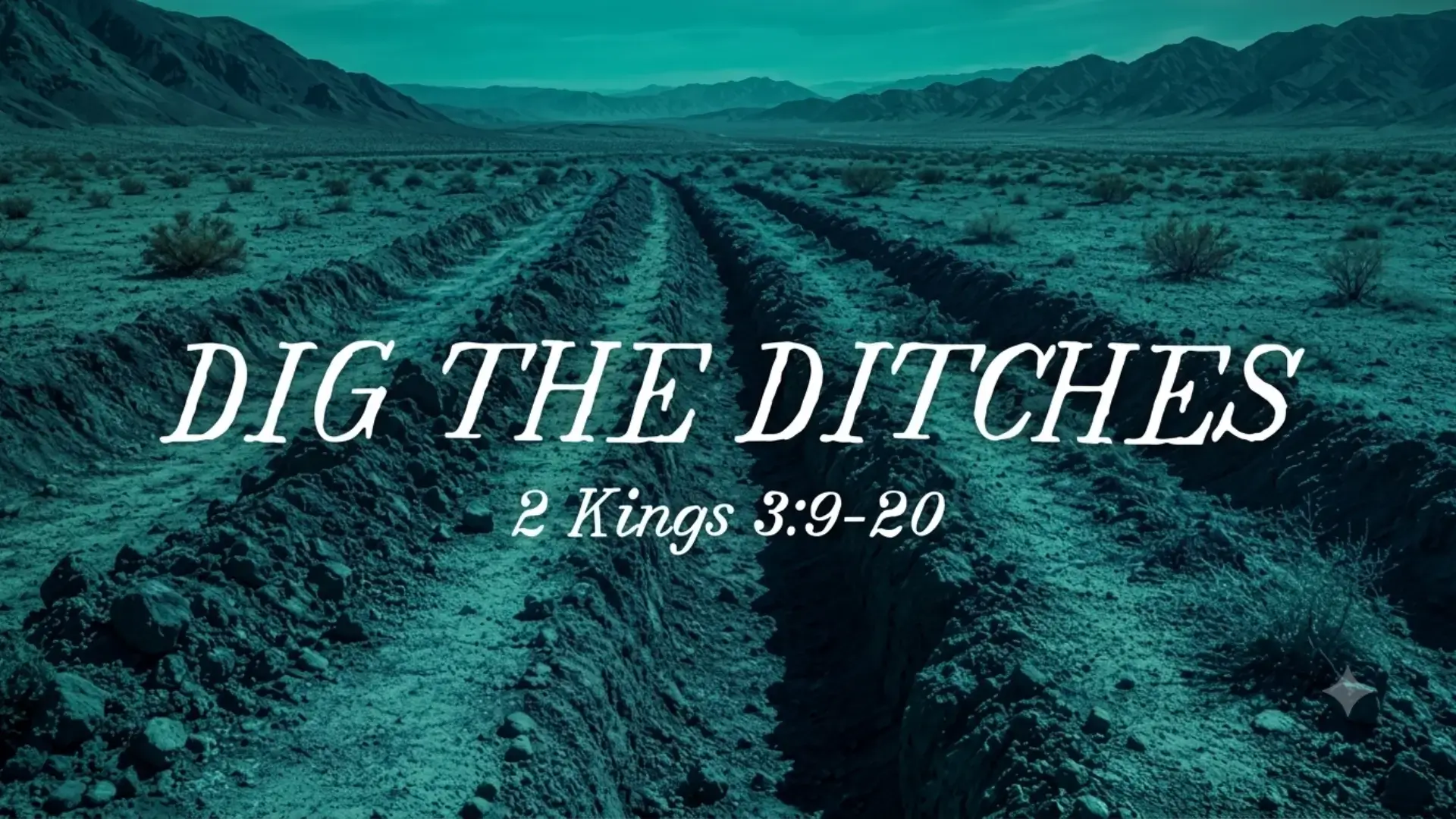
Thus saith the LORD, Make this valley full of ditches. For thus saith the LORD, Ye shall not see wind, neither shall ye see rain; yet that valley shall be filled with water, that ye may drink, both ye, and your cattle, and your beasts. (2 Kings 3:16-17, KJV)
The command must have seemed strange to the thirsty soldiers. They had marched for days under the hot sun. Their mouths were dry, their animals were weak, and now they were told to dig ditches in a dry valley. There were no storm clouds on the horizon. Human reasoning might have questioned the wisdom of expending more energy when water was already scarce. Yet God often withholds the full explanation and simply calls His people to obey.
Throughout Scripture we see this pattern. Noah was instructed to build an ark long before any rain appeared. Abraham was told to leave his homeland and go to a land God would later show him. Joshua and the priests were commanded to step into the overflowing Jordan River before the waters parted. In each case, obedience preceded the miracle. God invites us to trust Him enough to act before we understand how everything will work out.
The digging of ditches did not in itself produce the water. The men could prepare the ground, but only God could fill it. The same principle applies in the Christian life. We can witness to a loved one, but we cannot save a soul. We can pray for revival, but we cannot manufacture it. We can serve faithfully in ministry, but transformation belongs to God. Our part is to dig the ditch in obedience; God’s part is to send the water. Perhaps the Lord is asking you to renew daily devotions with your family, to continue serving in a place where you feel unseen, or to keep sharing the gospel with someone who has rejected it repeatedly. Whatever the command, remember that your obedience is never wasted. It prepares the way for God to do what only He can do.
The Confidence (2 Kings 3:17-19)
The promise that followed carried remarkable assurance.
And this is but a light thing in the sight of the LORD: he will deliver the Moabites also into your hand. And ye shall smite every fenced city, and every choice city, and shall fell every good tree, and stop all wells of water, and mar every good piece of land with stones. (2 Kings 3:18-19, KJV)
God not only promised water without wind or rain but declared that supplying it was a light thing in His sight. To the soldiers suffering from thirst, the need was urgent and overwhelming. Their campaign could fail if they lacked strength. Yet compared to the power of the God who created the heavens and the earth, hung the stars in place, and measures the oceans in the hollow of His hand, it required no great effort from Him.
This truth remains unchanged for us. We may face situations that appear impossible: a wayward child who shows no sign of returning to the Lord, a marriage marked by deep hurt, a serious health diagnosis, or the salvation of someone we have prayed for over many years. These burdens feel heavy to us. We may pray with a sense that we are asking God to accomplish something nearly impossible. Yet Scripture assures us that no prayer causes God to wonder how He might intervene. To Him, it is but a light thing. Our problems only seem overwhelming when we lose sight of how overwhelmingly great our God truly is. The water in the valley served as preparation for a greater victory over Moab, reminding us that God’s provision often exceeds the immediate need.
The Confirmation (2 Kings 3:20)
The following morning brought exact fulfillment of the promise.
And it came to pass in the morning, when the meat offering was offered, that, behold, there came water by the way of Edom, and the country was filled with water. (2 Kings 3:20, KJV)
Water flowed into the valley from the direction of Edom until every ditch was full. There had been no rain and no wind. The supply appeared precisely as God had said. The soldiers who had gone to sleep exhausted, thirsty, and perhaps doubtful awoke to find fresh water available for themselves and their animals. Their strength was renewed, and their fears were replaced with confidence.
God intentionally worked in a way that left no room for human credit. While the people rested, He prepared the miracle they needed. Later, when the Moabites saw the water-filled ditches from a distance, the reflection looked like blood. They assumed the three kings had fought among themselves and that the liquid was the blood of the defeated. Overconfident, they advanced to plunder, only to be soundly defeated. Once again, God alone received the glory.
This account encourages us that God remains at work even when we see little evidence of progress. We may pray faithfully for years without visible change. We may serve diligently without immediate results. Yet while we labour in obedience, God continues His work behind the scenes. Answers sometimes arrive so specifically and unexpectedly that the only reasonable explanation is that God Himself provided. Every blessing we receive is meant to draw our hearts back to the One who graciously supplied it. As Luke 12:7 reminds us, even the very hairs of our head are all numbered. We are of more value than many sparrows, and our God is neither distant nor indifferent to our needs.
Conclusion
The story of the three kings in the wilderness offers a timeless challenge. God calls us to dig ditches in the dry valleys of life before we see the water. He asks us to obey His Word, to continue in prayer, to serve faithfully, and to trust His promises even when circumstances give little encouragement. The same God who filled the valley without rain or wind is still faithful. His power has not diminished, and His timing remains perfect. Whatever burden you carry tonight, whatever impossible situation you face, remember that it is but a light thing in the sight of the Lord. Do not wait until you see the water before you begin to dig. Step forward in faith and obedience, and watch what God will do while you rest in His faithfulness.