
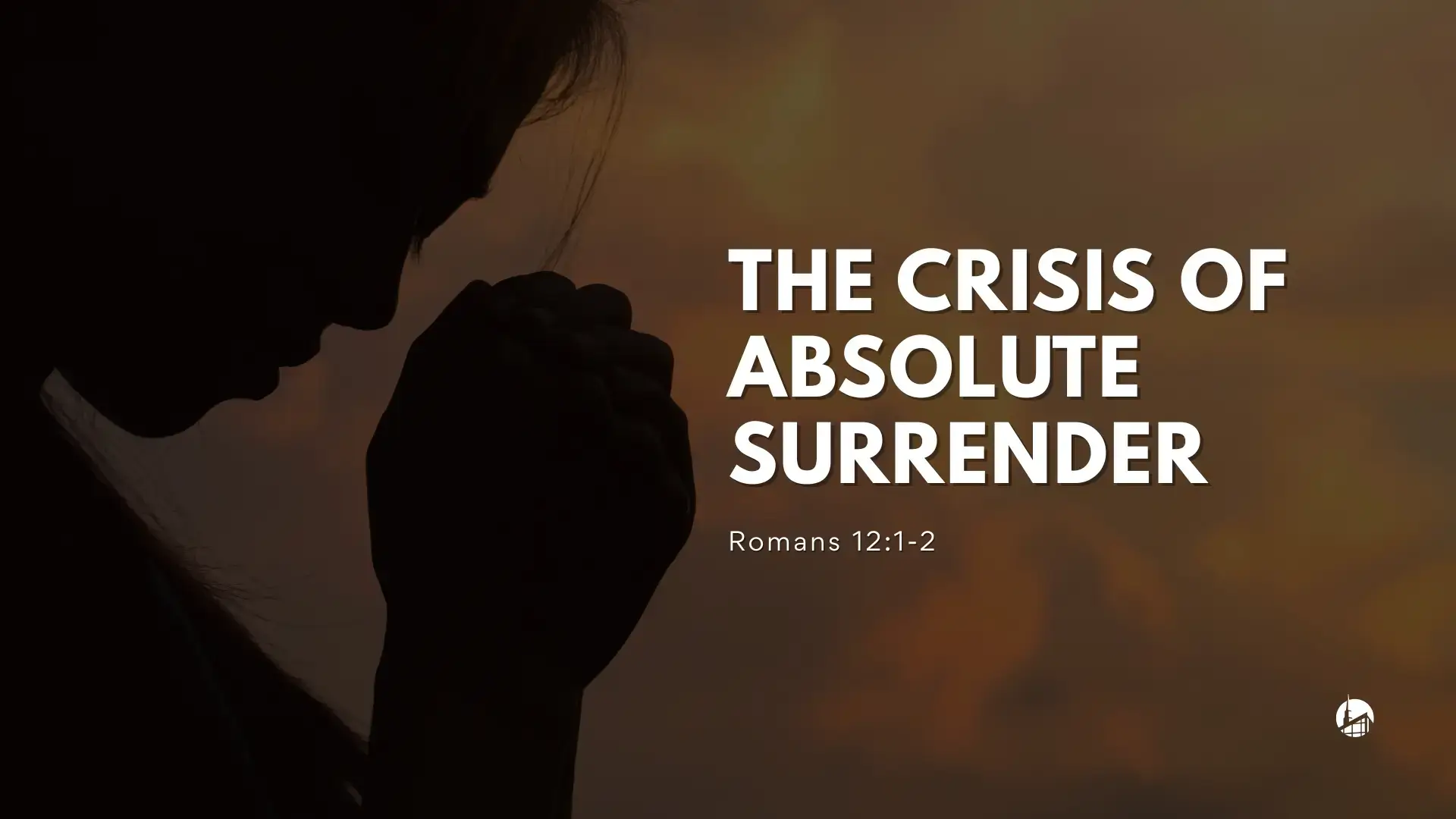
In Romans chapter 12, verses 1 and 2, the apostle Paul addresses a matter that stands at the centre of the Christian life: the crisis of absolute surrender. The longing for the church is that every believer, from the youngest to the oldest, would fully yield to the Lord for whatever He may have planned. There are people in the Turks and Caicos who need the gospel. There are needs across the Caribbean, in Ottawa, Montreal, the Durham region, and in Toronto itself, a city of more than seven million with only a smattering of gospel-preaching churches. The needs are tremendous, and the Lord wants to use every life. Yet He will not truly use a person until He owns that person.
A neighbour may leave a pressure washer on the driveway, but no one borrows it because it does not belong to them. The same principle holds in spiritual things. God uses what He owns. Although He has purchased every believer by the blood of Christ, the searching question remains: have we truly and fully surrendered and relinquished control of our lives to Him?
The Scripture says, “I beseech you therefore, brethren, by the mercies of God, that ye present your bodies a living sacrifice, holy, acceptable unto God, which is your reasonable service. And be not conformed to this world: but be ye transformed by the renewing of your mind, that ye may prove what is that good, and acceptable, and perfect, will of God.”
Missions and service do not begin by looking at maps. They begin at an altar. It is not an atlas issue; it is an altar issue. Parents must also place their children on that same altar. Sometimes it is more difficult to say, “Lord, send my children,” than to say, “Lord, send me.”
Remember the Mercies That Claim You
Paul begins with the foundation: “I beseech you therefore, brethren, by the mercies of God.” Missions and every form of Christian service begin with God’s mercy. Many motives can send a person overseas or into some form of service. Compassion for the needy, or even guilt over an affluent lifestyle, may drive humanitarian work. One woman once described herself as a missionary while openly stating she was an atheist who simply built schools and dug wells. Such work may be useful, but it is not the motive Scripture presents.
The right motive is this: God has forgiven so much that He owns the life He has redeemed. Bob Bowen, a veteran missionary long involved in Scripture distribution, once said that more than fifty years after his conversion he had never gotten over the fact that God would rescue a sinner like him. Gratitude for mercy kept him serving.
Otto Koenig, known for The Pineapple Story, learned the same lesson in Papua New Guinea. Chronic theft by the people he had gone to reach produced deep resentment in his heart. God used that bitterness to show him that he was not there primarily because the people were attractive. He was there because of the mercy of God that claimed his own life. Many things can get a person to a place of service; only the right motive will keep them there.
Present Our Bodies Without Reservation
The call continues: “that ye present your bodies a living sacrifice.” This is a present-tense demand. Any delay in offering one’s life is disobedience dressed as postponement. In Luke chapter 9 a man declared, “Lord, I will follow thee whithersoever thou goest.” Jesus answered that the Son of man had nowhere to lay His head, and the man is never heard from again. Gratitude to God always releases control of self.
A.D. Pearson observed that if missions languish, it is because the whole life of godliness is feeble. The command to go is not obeyed until the will is lost by self-surrender in the will of God. In the Old Testament, worshippers brought grain or animals to the altar. In the New Testament the believer must climb onto the altar himself.
Dixon Edward Hoste of the Cambridge Seven, after hearing D.L. Moody and reading Hudson Taylor, realised that serving Christ required the same complete surrender he had once given to the British military. A recruit does not dictate the place of service; he simply surrenders and then goes where he is sent. Presenting the body without reservation means ceasing to act as though life still belongs to self. Because of the mercies of God it no longer does.
Surrender is not a one-time event. Remaining surrendered can prove harder than the first act of yielding. Families and churches must stay on the altar, willing to go wherever the Lord directs, whether that is across the street or across the ocean.
Refuse the World’s Mould for Our Future
Paul adds the necessary counterpart: “And be not conformed to this world: but be ye transformed by the renewing of your mind.” In first-century Rome the culture pressed believers to honour the emperor as a god and to offer sacrifices to the deities of their trade guilds. Refusal could cost a livelihood. Today the pressure is different yet real. Society still possesses moulds it tries to force people into, and even segments of North American Christianity can impose expectations that hinder obedience.
Moulds never produce servants of God. A creative God transforms the mind from the inside so that His priorities become the believer’s priorities. Parents may teach, counsel, and warn, but they must never stand between their children and the clear call of God. One young man once came forward at a youth conference to surrender to preach or to missions, only to face a father who forbade it. The conflict between a parent’s dreams and the Spirit’s leading is heartbreaking. God never does the same thing twice; He deals with each child uniquely, always consistently with His Word, yet never according to rigid human blueprints.
William Borden, heir to a vast dairy fortune, turned from corporate succession to the China Inland Mission. After studying Arabic in Cairo so he might reach the Gansu Muslims, he died at twenty-five of spinal meningitis. His life is summarised in three short statements found in connection with his Bible: “No reserves. No retreats. No regrets.” Those who place everything on the altar never regret the surrender. The Lord takes far better care of whatever is yielded to Him than any human hands ever could.
The crisis of absolute surrender is settled at the altar, not on a map. Does Christ own the life? Does He own the family? The moment God showed mercy, forgave sin, and wrote a name in the Lamb’s book of life, He became worthy of everything. If the Lord is not Lord of all, He is not Lord at all.
May every believer, every family, and the entire church leave their lives on the altar. He is worthy, merciful, and gracious, and He deserves all.