
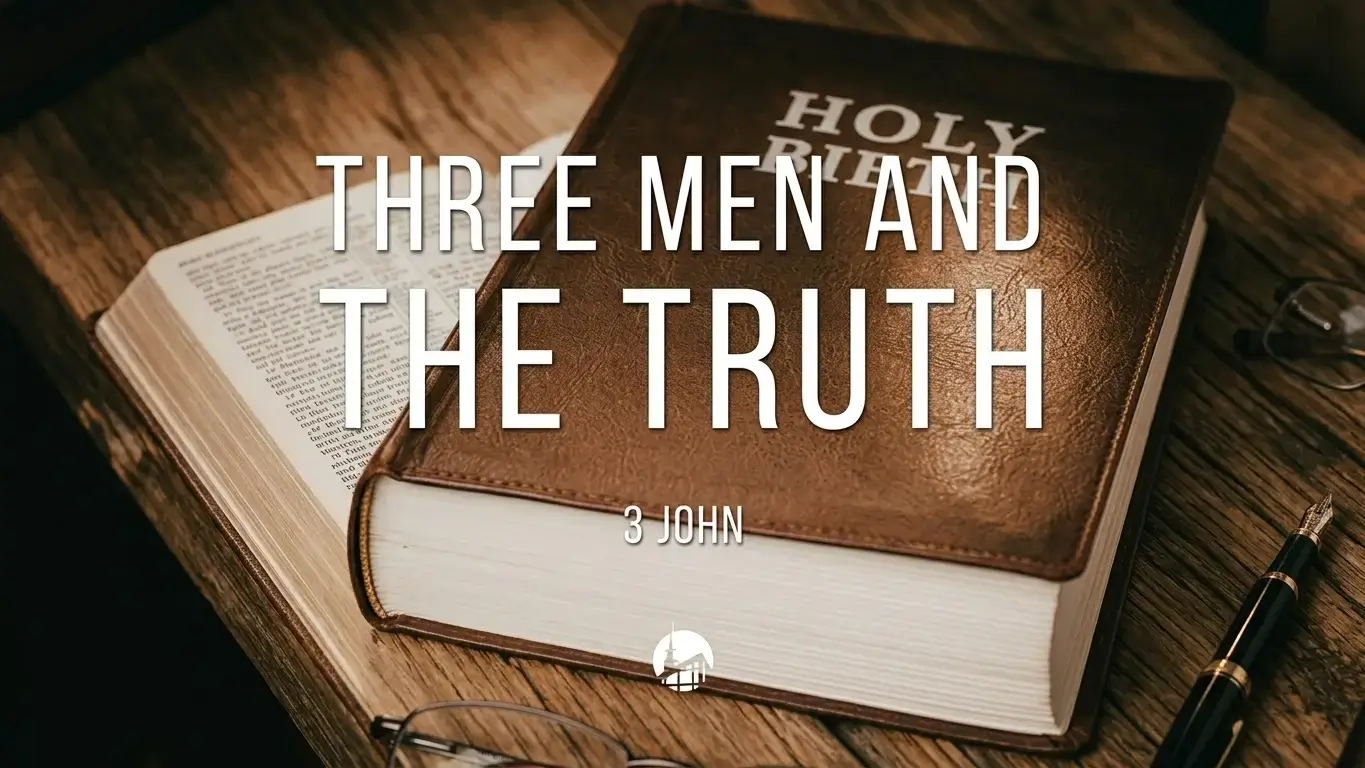
As the church completed its walk through John’s epistles, 1 John had occupied several weeks, 2 John the previous Sunday, and now the short letter of 3 John stood near the end of the New Testament, just before Jude and Revelation. Pastor Léveillé titled the message Three Men and the Truth because the letter introduces three men, presumably in the same local church, who responded to the truth in very different ways.
Who are you becoming like? Children often name a career they hope to have, and they also name a person they hope to resemble. Posters of athletes once lined bedroom walls. Later it became clear that sporting skill is not the same as a pattern of life worth copying. The more searching question is not which celebrity we once admired, but who we are becoming, because that direction reaches our homes, our influence, and the future of ministry. Supremely, believers are called to be like Jesus Christ, the perfect God-man. Even so, human examples still leave a mark, for good or for ill.
John writes to Gaius. Beside him stand Diotrephes, a man Gaius must refuse to imitate, and Demetrius, a man whose life is worth following. Through these three, the letter presses a single claim: truth is not only something we believe. It is something we practise. It is something we walk.
Walking is repeated steps. It is a pattern, a choice made again and again, an attitude or disposition that becomes ordinary. Walking in forgiveness means choosing to forgive the next offence, and the next. Walking in love means loving the next person, and the next. John does not merely want his children to know the truth. He wants them to walk in it.
The question, then, is not only which of the three men looks admirable on the page. The question is more personal. Of these three men, which one am I becoming today? What direction marks my life? The life choices made day by day will answer that more honestly than a title or a confession.
Walk in the Truth You Believe (vv. 1-4)
“The elder unto the wellbeloved Gaius, whom I love in the truth. Beloved, I wish above all things that thou mayest prosper and be in health, even as thy soul prospereth. For I rejoiced greatly, when the brethren came and testified of the truth that is in thee, even as thou walkest in the truth. I have no greater joy than to hear that my children walk in truth.” (3 John 1-4)
John, the elder, writes to well-beloved Gaius, whom he loves in the truth. His wish that Gaius may prosper is not a promise of financial wealth. To prosper here is to make progress. John hopes that Gaius will go forward and be in health, even as his soul prospers.
The brethren did not report that Gaius was merely clever with Scripture, able to explain most verses and settle every Bible question. They testified of the truth that was in him, even as he walked in the truth. To know Gaius was to know a man whose life had a clear direction. Time after time, situation after situation, he made choices that lined up with what God has said. He was not sinless. He would have had missteps. Still, those who watched him could expect the biblical thing, the loving thing, the right thing.
Every week brings decisions, wounds, and moments when doing right or doing wrong hangs in the balance. The accumulation of those choices becomes a walk, a repeated series of steps. People already know how we walk. A parent’s response to a mess, a boss’s response to lateness, a believer’s response on Monday morning and on the Wednesday commute, all of it forms a pattern others learn to expect. When someone who is ordinarily kind appears suddenly harsh, the disappointment itself contains a compliment: that outburst is odd because it is not the usual walk.
Verse 3 holds two phrases together: the truth that is in thee, and thou walkest in the truth. No one can walk in truth who does not first know the truth. Eternal truth is not a set of mathematical or scientific facts. Jesus said, “I am the way, the truth, and the life: no man cometh unto the Father, but by me” (John 14:6). The only way to be accepted by God is to know the One who is the truth. Has there been a moment of turning from self, good works, and religious performance to trust Christ alone for the forgiveness of sin? The truth was in Gaius, and Gaius then walked in the truth.
A childhood phrase from Swedish, Jag kan själv, meaning “I can do it myself,” captures a spiritual instinct that still lingers in many hearts. We want to make up for our own sin. Yet the gospel calls us to stop relying on what we can do and to rest in what Jesus has done. Once that trust is in place, the Word of God is meant to become the ordinary course of life. Faith ought to be visible. A walk is faith in work clothes. The question is not only whether we believe the truth, but whether we are walking in the truth we believe.
Invest in the Work of the Truth (vv. 5-8)
“Beloved, thou doest faithfully whatsoever thou doest to the brethren, and to strangers; which have borne witness of thy charity before the church: whom if thou bring forward on their journey after a godly sort, thou shalt do well: because that for his name’s sake they went forth, taking nothing of the Gentiles. We therefore ought to receive such, that we might be fellowhelpers to the truth.” (3 John 5-8)
In 2 John, the apostle warned the elect lady not to use her house and resources to enable the spread of what is false. First-century teachers depended on hospitality. A host might give a bed, a meal, and even a room that became a classroom. To open a home to error was to help error travel. In 3 John the emphasis turns positive. It is not enough to refuse falsehood. Believers must help the truth go forward.
Gaius did faithfully whatever he did to the brethren and to strangers. In context those strangers were not random visitors only. They were people connected to the work of the truth, whose charity had been reported before the church. To bring them forward on their journey after a godly sort was to do well. They had gone out for the name of Jesus, taking nothing of the Gentiles. They were not leaning on the world to fund the mission. They stepped out by faith, and the church was to receive such workers so that it might be fellowhelpers to the truth.
John appreciated Gaius’s personal walk. He also wanted that walk to include participation in the work of those who carry the gospel. The application remains close at hand. A missionary family travelling toward Ghana can be lodged, fed, encouraged, and, as the Lord leads, supported so that the gospel reaches people who have not yet heard the name of Christ. Those who go are vital. Those who hold the ropes for those who go are vital as well. From one local church, families have gone to places such as Indonesia, St. Lucia, Bolivia, and other fields. The congregation that stays is called to help them as God uses them there.
An Old Testament picture sits in 1 Samuel 30. After the Amalekites had taken the families and goods of David and his men, some went to battle while others stayed by the stuff. When the spoil was recovered, those who fought wanted to keep it for themselves. David refused. Those who went to the fight and those who guarded what was left behind would share the victory together. “For who will hearken unto you in this matter? but as his part is that goeth down to the battle, so shall his part be that tarrieth by the stuff: they shall part alike” (1 Samuel 30:24).
Material blessing can quietly teach the wrong lesson. Living in a country of unusual provision, it is easy to assume that God places resources in our hands only to make us more comfortable. What if He places them there so that the gospel can travel farther? What if something entrusted to us exists because someone else is meant to be helped by it? A spare bedroom used for gospel workers, a table opened to those passing through, a gift that sends another believer onward: these are ordinary ways of becoming fellowhelpers to the truth. The question is practical. What can my hands do so that the Word of God reaches more people?
Choose Carefully the Example You Follow (vv. 9-12)
“I wrote unto the church: but Diotrephes, who loveth to have the preeminence among them, receiveth us not. Wherefore, if I come, I will remember his deeds which he doeth, prating against us with malicious words: and not content therewith, neither doth he himself receive the brethren, and forbiddeth them that would, and casteth them out of the church. Beloved, follow not that which is evil, but that which is good. He that doeth good is of God: but he that doeth evil hath not seen God. Demetrius hath good report of all men, and of the truth itself: yea, and we also bear record; and ye know that our record is true.” (3 John 9-12)
After the call to walk in truth and to invest in its work, John turns to example. Two men stand before Gaius. Diotrephes is the warning. Demetrius is the pattern.
Diotrephes loved to have the preeminence. Even a letter from the apostle John was refused. “You have me,” the attitude said. “What else could you possibly want?” If John came, he would remember the deeds: malicious talk, a closed door to travelling brethren, a ban on those who would receive them, and the casting of faithful people out of the church. The demand was stark. Stand with Diotrephes or be expelled.
John answers with a clear command. “Beloved, follow not that which is evil, but that which is good.” Diotrephes’s root problem was the opposite of the mind of Christ. Colossians teaches that Christ must have the preeminence in all things. Philippians shows the path He took to that place: “Let this mind be in you, which was also in Christ Jesus: who, being in the form of God, thought it not robbery to be equal with God: but made himself of no reputation, and took upon him the form of a servant, and was made in the likeness of men: and being found in fashion as a man, he humbled himself, and became obedient unto death, even the death of the cross” (Philippians 2:5-8).
The same Lord, on the night His disciples argued about greatness, wrapped a towel around His waist, knelt with a basin, and washed their feet. Peter resisted, then asked for more than his feet once he understood that fellowship with Christ required this cleansing. Jesus served. Diotrephes would not. He loved first place. He rejected even apostolic authority. He spoke against those he could not control, refused faithful workers who did not serve his purposes, and punished those who would not follow him. Pride rarely stays private. When it becomes a walk, it damages other people.
The qualifications of an elder in 1 Timothy 3 warn that a novice must not be set in office, “lest being lifted up with pride he fall into the condemnation of the devil” (1 Timothy 3:6). Anyone who thinks himself the chief does not have the mind of Christ. Skill, volume, wealth, a polished public image, or a large following cannot replace humility. Character matters more than charisma. Faithfulness matters more than prominence. A good testimony matters more than a title. Diotrephes was influential. That did not make him godly.
Against that dark portrait John sets Demetrius. He has a good report of all men and of the truth itself. John also bears record, and the readers know that record is true. In biblical terms, two or three witnesses establish a matter. The truth itself, other believers, and the apostle all speak well of this man. His life has the pattern of walking in the truth. John leaves Gaius with two examples and a charge: choose carefully which one you follow.
We naturally become like the people we admire. We tend to copy their choices and to teach our children the same paths. Parents, grandparents, teachers, and older believers are already setting a tone. Younger eyes are watching how we handle authority, disagreement, correction, and criticism. Turn attention toward people who look like Jesus, who live for Him and like Him, who are humble rather than eaten up with pride. Paul could say, “Be ye followers of me, even as I also am of Christ” (1 Corinthians 11:1). Admire the Christlike person, not merely the successful one.
Conclusion
The most important question raised by 3 John is still the first one. Do you know the truth? The Bible was given to introduce us to a Person whose name is Jesus Christ. He is the way, the truth, and the life. He paid at the cross for every thought, word, and deed that is wrong. Forgiveness is not gained by trying harder, joining a church, or becoming more religious. It is received by trusting Jesus Christ alone and His payment for sin. He has power to forgive because He is God made flesh, and He is willing to save.
Those who already know Him must not leave the truth in the head. The pattern of life is meant to match the Word. Walk in the truth you believe. As God gives opportunity, invest in the work of the truth. Choose carefully the example you follow. The perfect example is Christ. No one is saved by copying His example. Salvation comes by believing that His sacrifice is sufficient. Then, in that relationship, His people walk with Him and walk in truth.
May the church refuse the spirit of Diotrephes, which loves preeminence, and put on the humility and servant heart of Christ. May homes point children toward those who resemble the Saviour, not merely those who impress the world. And may the ordinary steps of this week, choice after choice, form a walk that makes the truth visible.